UFC Whitehouse Preview

There are “big UFC cards,” and then there’s UFC Freedom 250, live from the White House lawn in Washington, D.C., on June 14, 2026.
It’s a once-in-a-generation setting, and once again, Dana White continues to break barriers on what is possible in the world of live sporting entertainment.
Without further ado, let’s dive into each matchup on this historic UFC Whitehouse card.
Ilia Topuria vs Justin Gaethje
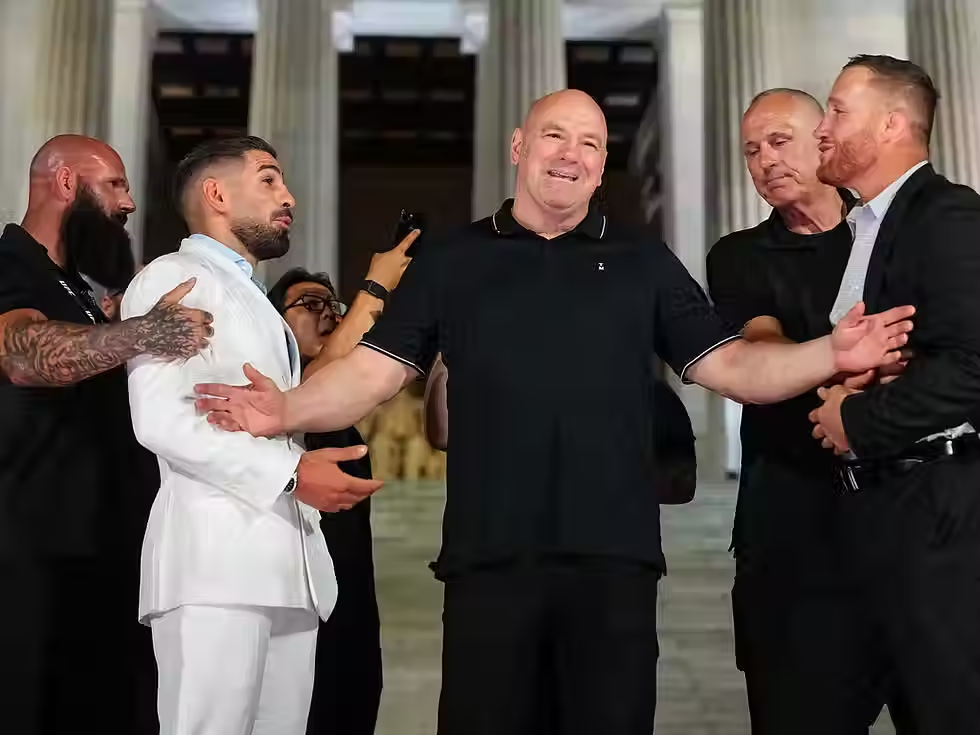
Ilia Topuria (17-0) is the kind of problem that makes veterans fight like they’re trying to outrun time.
His numbers tell the story of a modern champion who can do it all: 4.81 SLpM on 48% accuracy, 64% striking defense, and the wrestling/grappling backbone to fall back on(1.96 takedowns/15 min, 61% TD accuracy, and a ridiculous 93% takedown defense.
Stylistically, he’s compact, explosive, and vicious in the pocket, dangerous wherever the fight goes.
Justin Gaethje (27-5) is still the UFC’s most violent athlete.
He lands 6.48 SLpM at 58%, but he also absorbs a brutal 7.05 SApM, and that’s the tax you pay when you live in the pocket and dare people to trade. Gaethje’s takedown numbers (0.33 TD/15) have never been the point; it’s the threat of leg kicks, the pressure, and the fact that he’ll make a five-minute round feel like twenty.
The strategic key is whether he can force Topuria to fight at Gaethje's tempo without getting countered.
If Gaethje’s calf kicks and dirty boxing start freezing Topuria’s entries, the momentum will swing. But if he gets too eager, Topuria is one of the sharpest punishers in the sport right now.
We’ve seen this movie before. The dominant, seemingly unbeatable champion, with all the pressure on their shoulders, versus a challenger with nothing to lose. This is Gaethje’s “Rocky moment”, his last chance at undisputed gold.
And if we’ve learned anything from this crazy sport, it’s that nothing is impossible.
Alex Pereira vs Ciryl Gane

Alex Pereira (13-3) is looking to make history; the first UFC athlete to hold titles across three weight divisions.
He posts 5.16 SLpM with a wild 62% accuracy, and he doesn’t take nearly as much as people assume (3.50 SApM). At heavyweight, the power becomes pivotal, and Pereira’s whole game is built around making you pay for a single bad angle: left hook, left kick, check hook, and that unique ability to turn your mistakes into highlights.
Ciryl Gane (13-2, 1 NC) is the heavyweight technician who moves like nobody we’ve seen before. His stat line is impressive: 5.29 SLpM, 61% accuracy, and only 2.33 SApM absorbed with 60% striking defense.
For those who have not watched Gane, those are the numbers of somebody who floats on the outside, snaps opponents with quick strikes, and evades as no heavyweight has done.
The question is whether Gane can keep that smooth, layered movement without getting trapped on the outside of Pereira’s kicks or caught in the pocket on exit. Gane will have to fight his fight, circling the cage and using his elite footwork. Still, the cleanest win for Gane is classic: touch, slide, make Pereira reach, and punish the reset.
Dana White said it himself: if Pereira can emerge victorious, he will be the GOAT. That is a lot of pressure to put on the 38-year-old, but one thing we know is that there isn’t anyone who is as much of a big game hunter as Alex “Poatan” Pereira.
Sean O'Malley vs Aiemann Zahabi

Sean O’Malley (19-3, 1 NC) is looking for one more victory to get back into a title position.
O’Malley is a rhythm fighter with sniper confidence, and his stats back up the eye test. He lands 6.05 SLpM on 60% accuracy, while only eating 3.40 SApM, with 60% striking defense. He’s a switch-stance athlete with long reach for the weight class (72" reach) and a real gift for making opponents swing at air, then tagging them on the return. The strategic theme is range: O’Malley wants Zahabi at the end of the jab/teep and walking into counters, not chest-to-chest, where the exchanges get messy.
Aiemann Zahabi (14-2) is the kind of fighter people overlook until they’re in a close fight they didn’t expect. He’s efficient and defensively responsible: 4.54 SLpM, only 4.08 SApM, and a huge 69% striking defense; that’s a fighter who doesn’t panic.
His takedown stats are low-volume (0.12 TD/15, 14% accuracy) but serviceable as a mix-up, and his 83% TD defense matters if O’Malley tries to be pretty on the feet. Zahabi’s path is discipline: crowd the space behind feints, make O’Malley reset without giving him clean reads, and win minutes with smart pressure rather than chasing a highlight.
This matchup is tailor-made for the American-born O’Malley to add another knockout to his highlight reel, but like other fighters on this card, Zahabi is playing with house money, and a fighter with nothing to lose is a dangerous fighter.
Josh Hokit vs Derrick Lewis
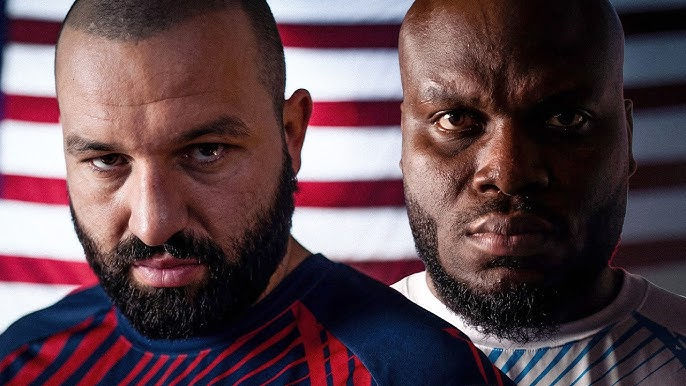
For years, the Heavyweight division has been searching for its next star. Josh Hokit not only brings chaos inside the cage, but continues to create viral moments on the microphone.
Hokit (9-0) is pure chaos on paper, in the best and worst way. 9.25 SLpM at 62% accuracy is an absurd output for a heavyweight, but it comes with the obvious warning label: he absorbs 6.81 SApM, and his striking defense is 44%. That’s the profile of a fighter who believes in his chin… and hasn’t yet been asked the Derrick Lewis question.
The wrinkle is that Hokit actually has a wrestling lane (3.89 TD/15), and if he’s smart, he’ll make Lewis carry weight early and force scrambles instead of standing in the pocket.
Derrick Lewis (29-13, 1 NC) remains the division’s scariest one-shot outcome.
The numbers don’t jump off the paper: low-ish volume (2.46 SLpM), shaky defense (39%), and yet it doesn’t matter because the moment he lands, the lights can go out. His wrestling metrics are what you’d expect (0.55 TD/15), and the takedown defense sits at 52%, which means Hokit’s grappling is the whole story here.
If Hokit shoots early and often, he can make this look easy. If he gets greedy in exchanges, Lewis will remind everyone why he is the UFC’s “knockout king”.
Mauricio Ruffy vs Michael Chandler
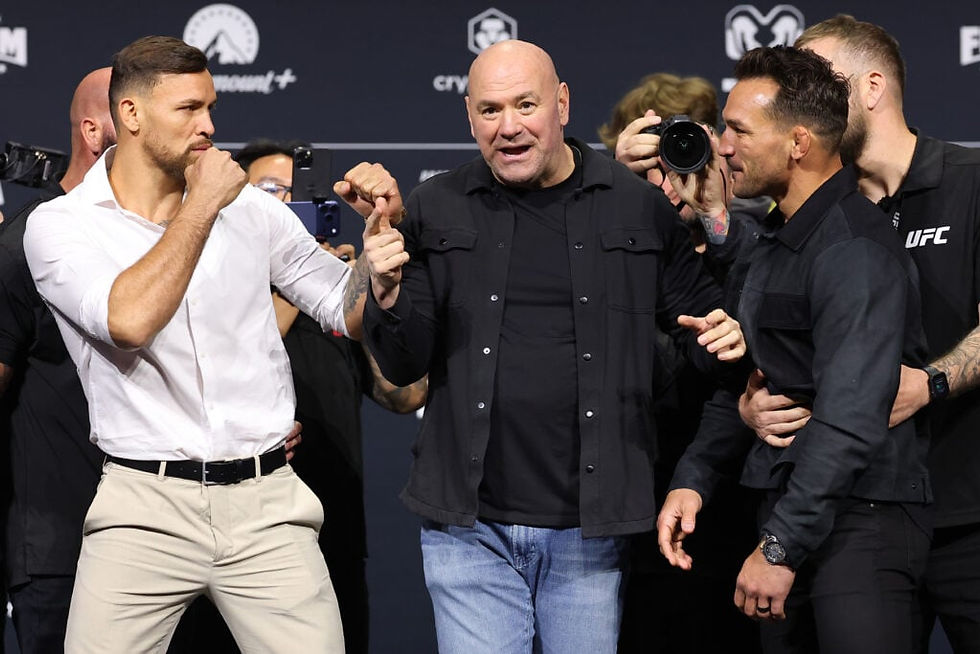
Mauricio Ruffy (13-2) is arguably the best technical striker in the UFC. He’s at 4.19 SLpM with 58% accuracy, basically even in what he gives and takes (4.09 SApM), and a strong 85% takedown defense that matters a lot against someone like Chandler.
Ruffy’s best version is measured: make Chandler miss big, punish the entries, and keep the fight in the middle where his timing can cook.
Michael Chandler (23-10) is still a walking car crash, but it’s a car crash with Olympic-level explosiveness and a real wrestling base (1.96 TD/15). He lands 4.04 SLpM but absorbs 4.52 SApM, and the striking defense (43%) tells you what you already know: Chandler is there to win exchanges, not avoid them.
The strategy is clear: can Chandler force grappling phases often enough (41% TD accuracy) to keep Ruffy from settling into a striking rhythm? If he can chain takedowns into fence work and make Ruffy fight tired, he drags this into deep water. If he can’t, Ruffy’s accuracy and composure could make Chandler’s usual chaos look reckless.
Despite Chandler’s subpar UFC record, he’s fought the murderer’s row of Lightweight contenders, and like it or not, he’s a star. Can he create an iconic American moment in the White House? We’ll see.
Bo Nickal vs Kyle Daukaus

Bo Nickal (8-1) is looking to make a statement and remind the Middleweight division that he’s a championship-caliber fighter.
His ground game is the key: 3.10 TD/15 and 2.5 submissions/15 with 100% takedown defense. That’s a style that forces opponents to constantly choose between giving ground on the feet or bracing for the shot. Strategy-wise, Nickal’s best approach is to make this a pace fight: threats, level changes, clinch pressure, and drowning Daukaus in decisions.
Kyle Daukaus (17-4, 1 NC) is a legit grappler with real finishing instincts (2.1 subs/15) and a solid takedown defense at 82%, which is exactly why this matchup is interesting. His striking is steady (3.32 SLpM, 53% accuracy), but his defense is leaky (42% striking defense), and that’s where Nickal can steal moments with straight shots while Daukaus is preoccupied with the wrestling threat.
Daukaus’ path is to survive the first wave, force scrambles instead of accepting bottom, and turn any overconfident shot into front-headlock threats and submission chains. Easier said than done, but if anyone on this card can make Nickal work for it, it’s a guy who likes grappling.
Diego Lopes vs Steve Garcia

If there was a fighter who maximizes excitement in a short period of time, Diego Lopes (27-8) is that guy.
His stats are aggressive but imperfect: 3.83 SLpM with 47% accuracy, absorbing 4.56 SApM, plus a meaningful submission rate (1.4 subs/15). Lopes’ game tends to bloom when the fight gets messy: scrambles, clinch moments, and any exchange where the opponent forgets defense for half a second.
Steve Garcia (19-5) is the kind of opponent you don’t want when you’re a little loose defensively. He’s efficient and tough: 5.39 SLpM, only 2.12 SApM, and 59% striking defense, plus a sturdy 88% takedown defense.
As a southpaw with reach (75"), Garcia’s lane is to keep this clean: punish entries, stay off the fence, and make Lopes pay for every reckless step into range.
Despite all the stats, records, and styles, it all goes out the window on June 14th. Nobody has fought on this big a stage. The whole world is watching, and we’re going to see who rises to the occasion and who drowns when the going gets tough. History will be made on June 14th; it’s just a matter of who can deliver the iconic moment that will be immortalized in UFC history.


Comments